A Mystery at MIT: The Architect's Daughter and the Postcard from 1907
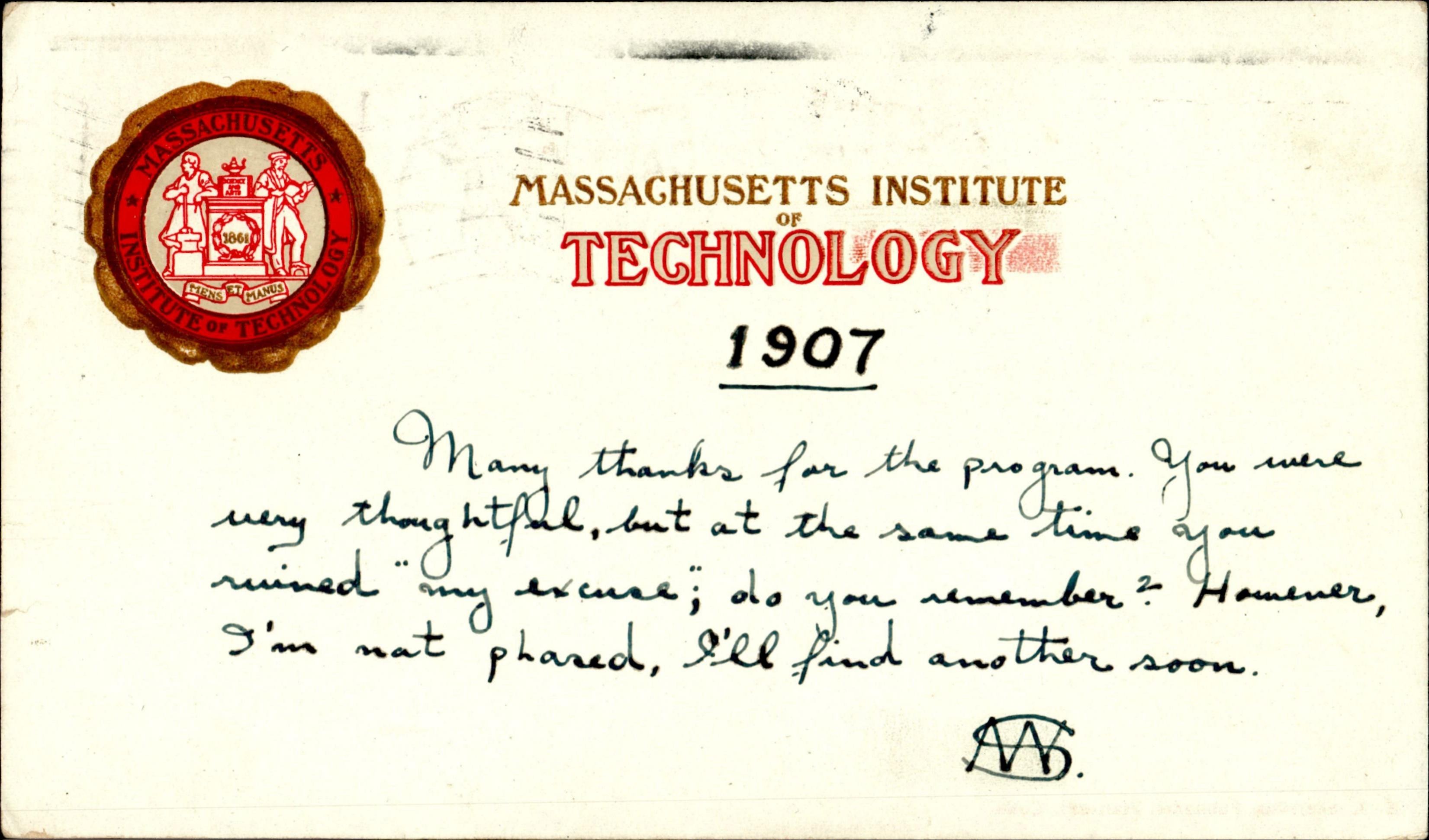
Front: The message, ending with the mysterious initials
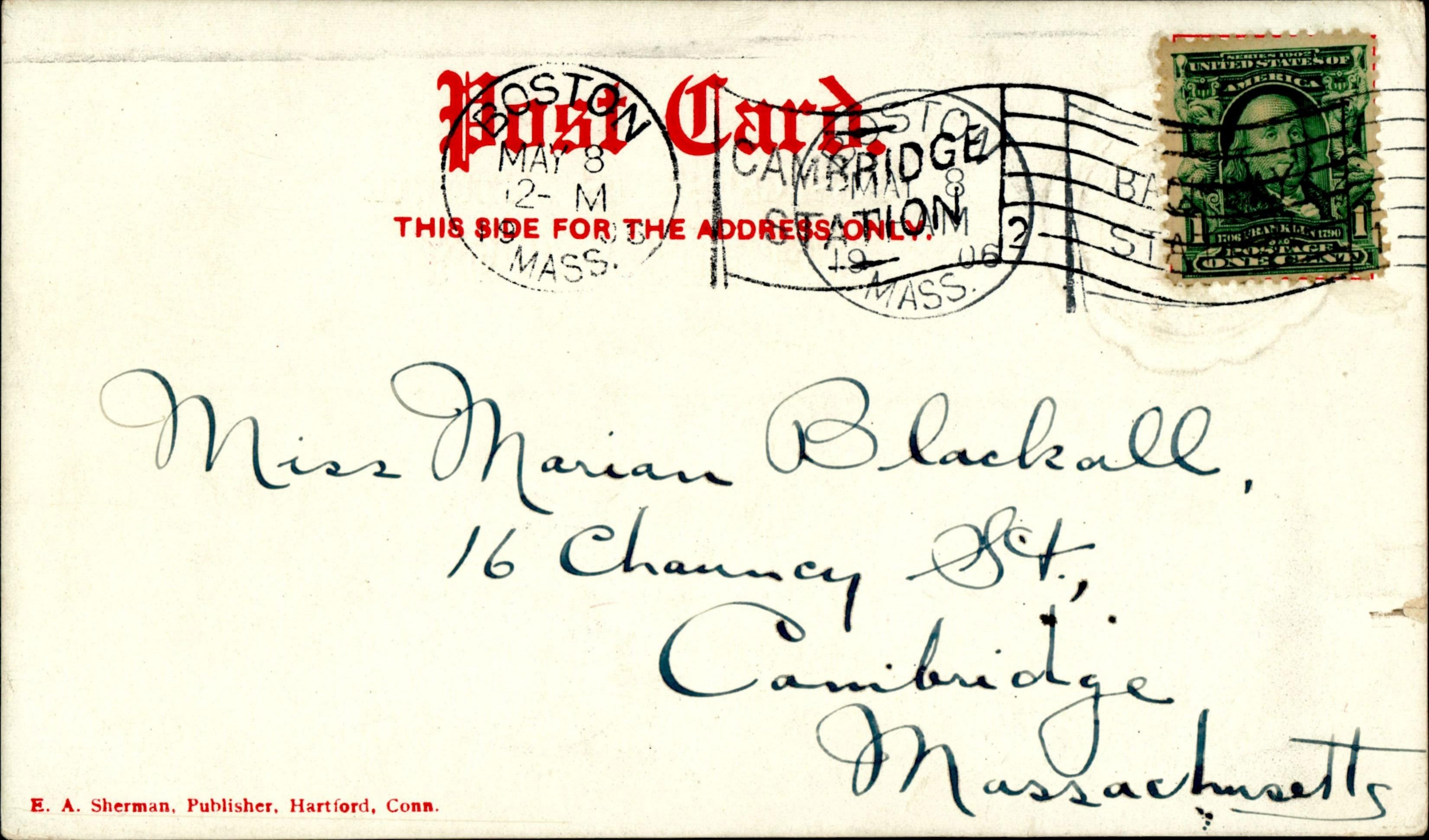
Back: Addressed to Miss Marian Blackall, 16 Chauncey St., Cambridge, Mass.
On May 8, 1907, someone at MIT — a male student, writing on university stationery at a time when women were not enrolled — addressed a colorful postcard to Miss Marian Blackall at her father’s home on Chauncey Street in Cambridge, Massachusetts.
The message is brief and teasing:
Many thanks for the program. You were very thoughtful, but at the same time you ruined “my excuse”; do you remember? However, I’m not phased, I’ll find another soon.
Marian was 19 — likely finishing high school or just beginning at Radcliffe. The sender was an MIT student, probably a senior about to graduate.
The card is signed with initials that look like W.S. — or possibly A.W.S.
I bought the postcard on eBay. What follows is what I found about the people behind it.
The Architect’s Daughter
Marian Blackall (1887–1987) grew up in one of the most architecturally significant households in Boston.
Her father, Clarence Howard Blackall (1857–1942), was one of the foremost architects in New England. He is estimated to have designed approximately 300 theaters, including many that still stand today:
- The Colonial Theatre (1900) — Boston’s oldest continuously operated theater, a Baroque and Rococo 1,700-seat auditorium on Boylston Street
- The Wilbur Theatre (1914) — still operating on Tremont Street
- The Metropolitan Theatre (1925) — now the Boch Center Wang Theatre, one of the largest in the world
- The Gaiety Theatre (1908) — notable as one of the only theaters in New England that allowed African American performers on its vaudeville stage
Beyond theaters, Blackall designed Boston’s first steel-frame building — the Carter Winthrop Building (1894) — and co-founded the Boston Architectural College in 1889. He won the first Rotch Travelling Scholarship from the Boston Society of Architects, studied at the École des Beaux-Arts in Paris, and served as chief draftsman for the eminent firm Peabody and Stearns before establishing his own practice in 1888.
The family lived at 16 Chauncey Street in Cambridge — a house that was later demolished and replaced by an apartment building that Blackall himself designed, reusing some of the original doors, mantle, and staircase. Clarence married Emma Lucretia Murray of Boston in 1883. They had two children: Marian and her brother Robert M. Blackall, who settled in Northampton.
Clarence Blackall died on March 5, 1942, at his daughter’s home in Concord, Massachusetts.
Sources: Wikipedia, Back Bay Houses, SAH Archipedia, Buildings of New England, Moakley Archive portrait, Find a Grave
Marian’s Life
Marian grew up surrounded by Boston’s cultural elite. The Cambridge Chronicle of April 18, 1908 records her at a meeting of the Cantabrigia Club — a Cambridge women’s organization — where “Miss Margaret I. English, accompanied by Miss Marian Blackall, sang two songs.” She was 20 years old, already participating in the cultural life of Cambridge.
She attended Radcliffe College, where she became president of the Idler Club — Radcliffe’s drama and theater society. Cambridge newspaper accounts describe her directing plays and performing in productions. The daughter of Boston’s greatest theater architect was, it turned out, running the theater club at her own college.
This detail reframes the postcard entirely. The “program” she sent the MIT student was almost certainly from an Idler Club production she had directed or performed in. And his teasing response — “you ruined my excuse” — takes on new meaning: perhaps her program gave him a reason to attend a Radcliffe event, depriving him of an excuse he’d been using to avoid something else.
Her scrapbooks from 1907–1929 are held at the Schlesinger Library at Harvard (catalog SC 8) — a tantalizing archive that likely contains programs, clippings, and correspondence from her years leading the Idler Club.
Around 1912, at age 25, Marian applied for a passport — listing her occupation as “Student” and noting she planned to travel abroad for two months. Her physical description: 5 feet tall, blue eyes, light brown hair, fair complexion, high forehead, straight nose, long face.
On April 17, 1915, she married Hans William Miller (age 26, from New York) in Cambridge. They moved to Concord, Massachusetts, where Marian became deeply embedded in the community:
- Children’s librarian at the Concord Free Public Library (1942–1957), where she taught cataloguing lessons and researched genealogical questions
- Secretary and president of the Concord Players (founded 1918) — a theater company for which her father designed the stage as “a replica, though smaller, of the Colonial Theater stage in Boston”
- Active in the Antiquarian Society, rising from “scraping the floor to being a director”
- Wrote a history of Trinity Church in Concord
- Helped build a lighthouse on the Sudbury River — approximately 15 feet tall, electrically lit from the house, that stood for about six years before being destroyed by ice and flooding
In a 1977 oral history interview at the Concord Free Public Library, conducted when she was 89, Marian recalled the Concord Players’ production of Clarence that was performed in New York with tennis champion Bill Tilden for Life’s Fresh Air Fund benefit. Her husband Hans wrote a history of the Concord Dramatic Club in 1952.
Marian Blackall Miller lived to the age of 100, dying in 1987.
Sources: Concord Library oral history, Cambridge Chronicle April 18, 1908, Find a Grave, Concord Players Collection, Schlesinger Library
Who Sent the Postcard?
The initials on the card have been read as A.W.S. or W.S. — but they definitively don’t match Hans W. Miller, the man Marian married eight years later. The sender was at MIT, writing on MIT stationery, at a time when MIT was all-male. The tone is playful, even flirtatious: “you ruined ‘my excuse’” — whether that means she distracted him from his studies or foiled some scheme of his, the intimacy is clear.
A search of the MIT Alumni Register (1948) turned up one initially compelling candidate: Winsor Soule (1883–1954), MIT Class of 1907 in Architecture, who went on to become a celebrated architect in Santa Barbara. An architecture student with a connection to the most famous theater architect in Boston — it seemed perfect.
But Brookline marriage records tell a different story. Soule married Judith Brasher de Forest — daughter of the noted artist and designer Lockwood de Forest — on October 19, 1907, just seven months after the postcard was sent. If he was already courting his future wife that spring, the flirtatious tone of the message makes him an unlikely sender.
The identity of A.W.S. remains a mystery.
What we know about the sender:
- Male, at MIT in March 1907
- Knew Marian well enough to tease her (“you ruined ‘my excuse’”)
- Grateful to her for sending a program — likely from a performance or cultural event
- Signed with initials that look like W.S. or A.W.S.
- Not Hans W. Miller (Marian’s future husband)
- Probably not Winsor Soule (engaged by this time)
The answer may lie in Marian’s scrapbooks from 1907–1929, held at the Schlesinger Library at Harvard (catalog SC 8). Or in the MIT class records for 1907–1910 — a graduating architecture student would have had the strongest reason to know the Blackall family, but students in other departments cannot be ruled out. The “program” she sent could have been from the Cantabrigia Club, a Cambridge theater production, or a Radcliffe event.
If you recognize the initials or have information about an MIT student connected to the Blackall family, please get in touch.
Sources: MIT Alumni Register 1948, Brookline MA Marriage Records 1907, PCAD, prabook
Primary Source Documents
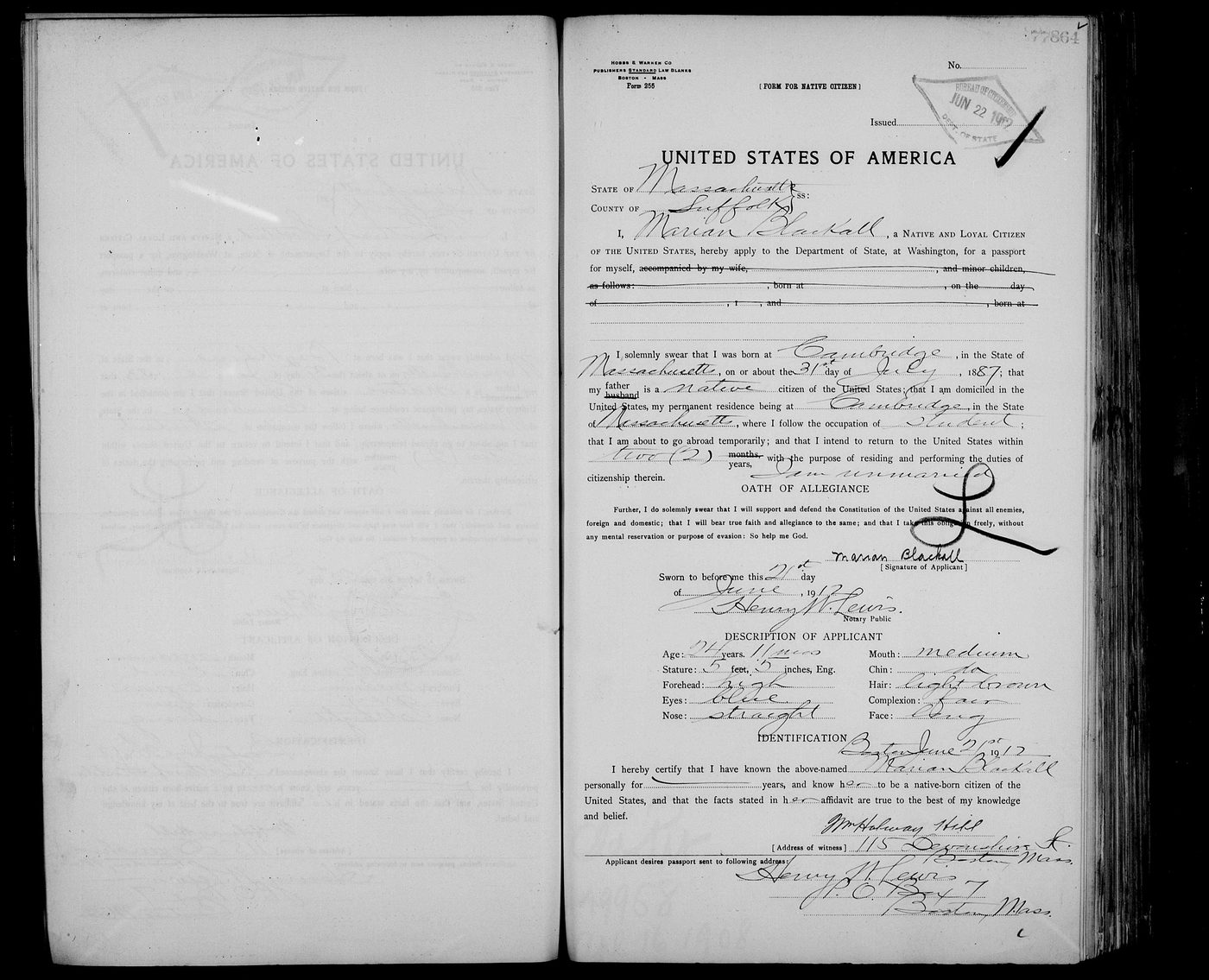
Marian Blackall's passport application, c. 1912. Age 25, occupation "Student," blue eyes, light brown hair, fair complexion. Born July 31, 1887 in Cambridge. Source: FamilySearch.
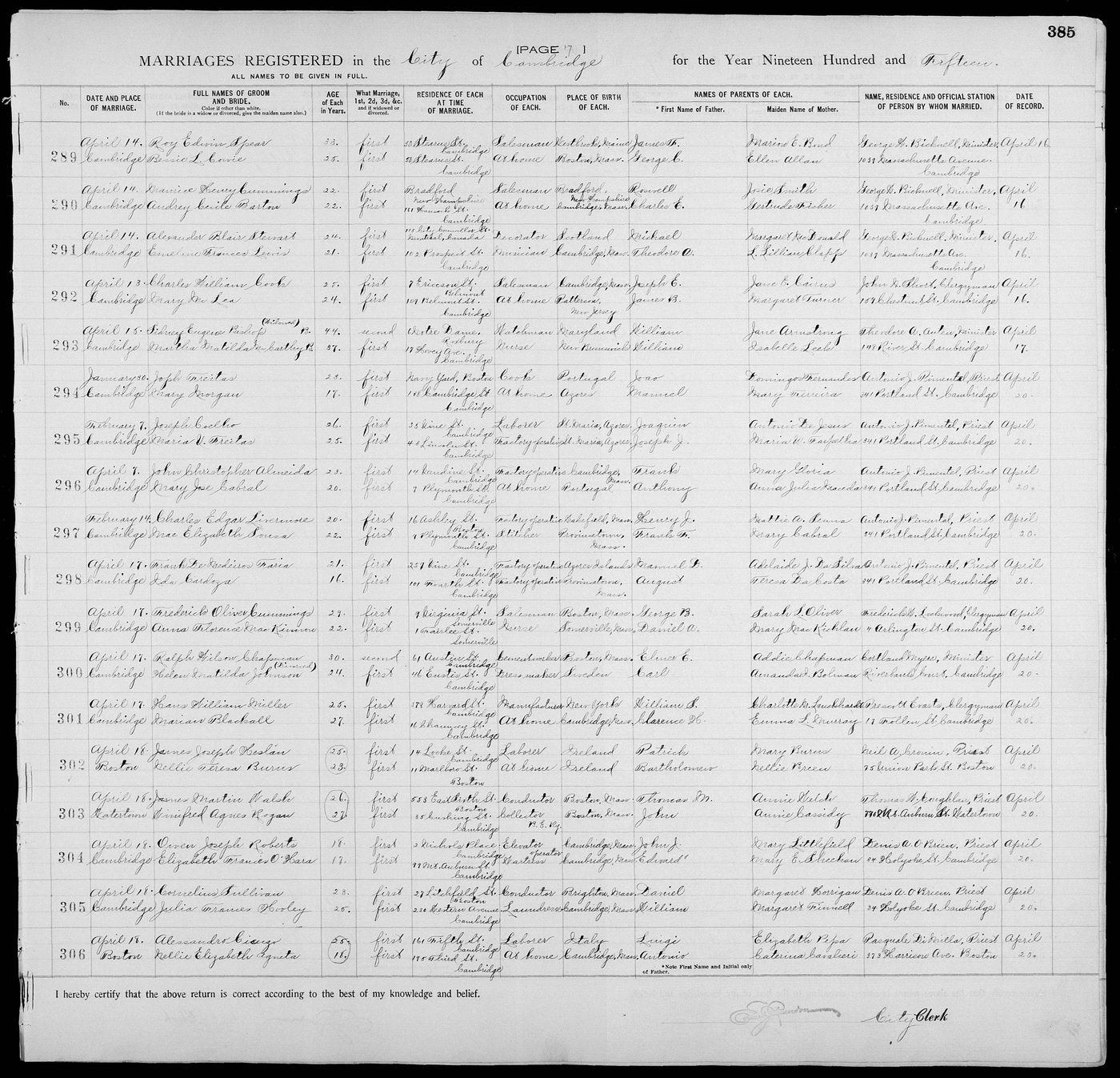
Cambridge marriage register, April 17, 1915: Hans William Miller (26, New York) married Marian Blackall (27, Cambridge). Parents: Clarence H. Blackall and Emma L. Murray. Source: FamilySearch.
Additional Primary Sources
The following Cambridge newspaper articles mention Marian Blackall between 1905 and 1910, available through the Cambridge Public Library’s Historic Newspaper Collection:
- Cambridge Tribune, March 11, 1905
- Cambridge Tribune, February 11, 1905
- Cambridge Chronicle, April 22, 1905
- Cambridge Chronicle, May 20, 1905
- Cambridge Chronicle, September 2, 1905
- Cambridge Chronicle, September 9, 1905
- Cambridge Tribune, June 10, 1905
- Cambridge Chronicle, April 18, 1908 — Cantabrigia Club: Marian accompanying a singer
- Cambridge Chronicle, April 2, 1910
- Cambridge Chronicle, June 25, 1910
- Cambridge Chronicle, July 23, 1910
- Cambridge Tribune, February 20, 1915 — possibly her marriage announcement
Other archival sources:
- Marian Blackall Miller scrapbooks, 1907–1929 — Schlesinger Library, Harvard (catalog SC 8)
- Concord Players Collection, 1919–1983 — includes writings by Marian B. Miller and Hans W. Miller
- Concord Dramatic Club Records, 1851–1961
- Radcliffe College yearbooks — Class of ~1909–1911 (e-yearbook.com)
- Winsor Soule marriage record — Brookline MA Marriages, Oct 19, 1907 (FamilySearch)
View the postcard in my collection →